
Teleoperation deck, episode recorder and a patched servo driver
The robot-side tooling behind the demonstrations. A browser control deck with gamepad teleoperation and layered stops, a recorder that writes episodes for training, and eight fixes to the vendor's servo driver, each with a measurement.
Project facts
- Robot
- Hiwonder JetRover. Mecanum base, 5-joint arm and gripper, lidar, depth camera, IMU
- Compute
- Jetson Orin NX 16 GB
- Teleoperation
- A browser deck over rosbridge, driven by gamepad, keyboard or on-screen sticks
- Recording
- rosbag2 episodes with a sidecar file for task, outcome and feature map
- Tests
- 362 automated test cases, plus a 36-check script run on the robot
- Built with
- ROS 2 Humble, Python, JavaScript, rosbag2, Flask
- When
- Aug 2026 to now
- Status
- In progress
- Code
- Private repository. I can walk through it on request.
- Page updated
Why this exists
A policy is only as good as its demonstrations, and the robot’s stock software could not record honest ones. A survey of the running robot found that two of its basic state signals are not measurements at all.
- The arm’s joint states are the commands, played back. The vendor’s stack stores each position it sends and republishes that value. Nothing reads the servos. Once I could measure them, an arm parked in its start pose read 505, 503 and 763 on three joints where the echo said 500, 500 and 765.
- The base’s position is integrated from commanded velocity. The controller board sends no wheel data to the computer. A stalled or lifted robot still “drives” in its odometry.
Recording actions next to states that are copies of those actions teaches a policy nothing. So before any learning there was infrastructure to build: a way to drive the robot safely, a way to record what happened, and a driver that reports what the servos really did.
The control deck
The deck is a page served by the robot. It talks to ROS through rosbridge, shows the camera through a rate-limited proxy, and needs no build step: plain JavaScript modules.
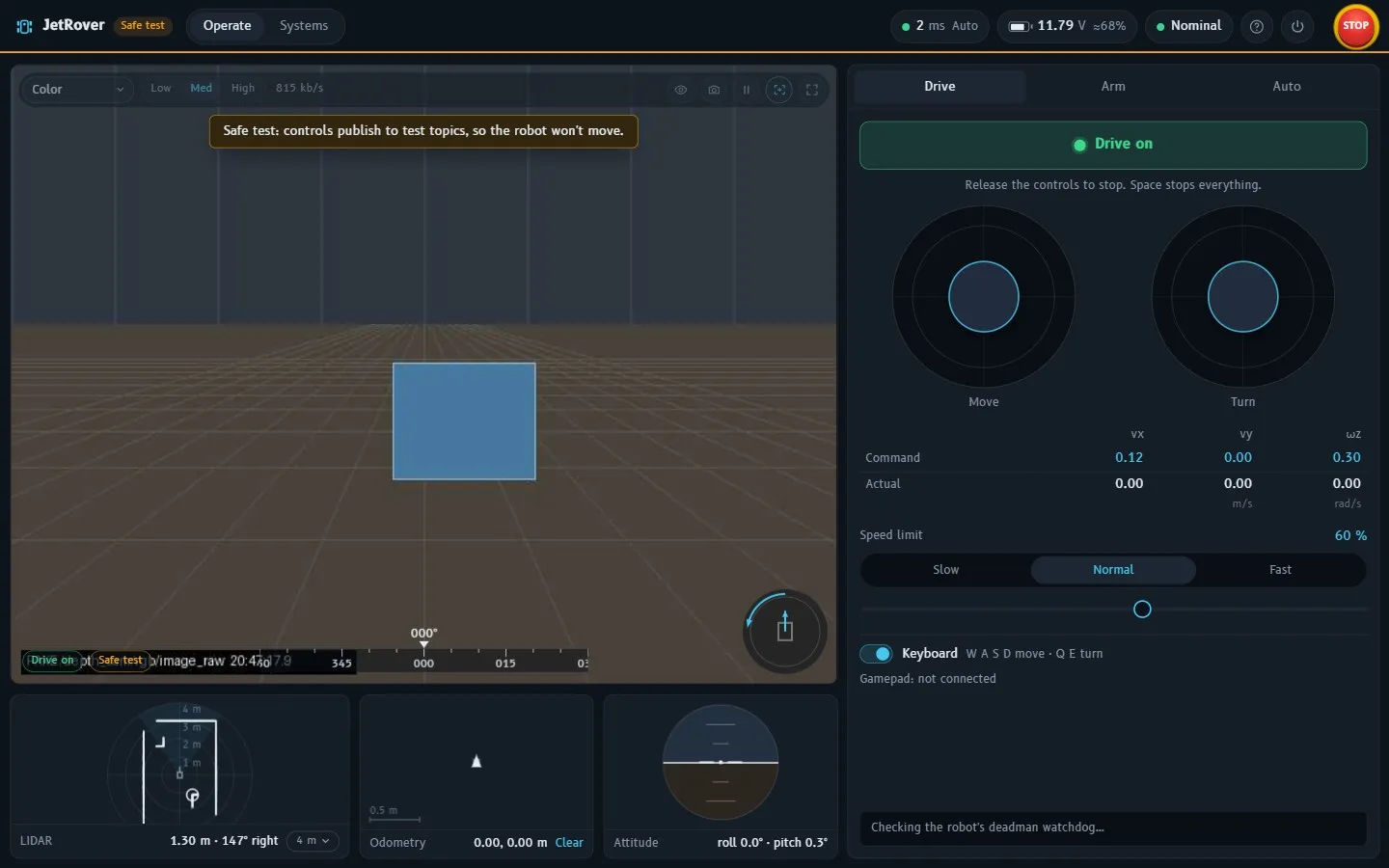
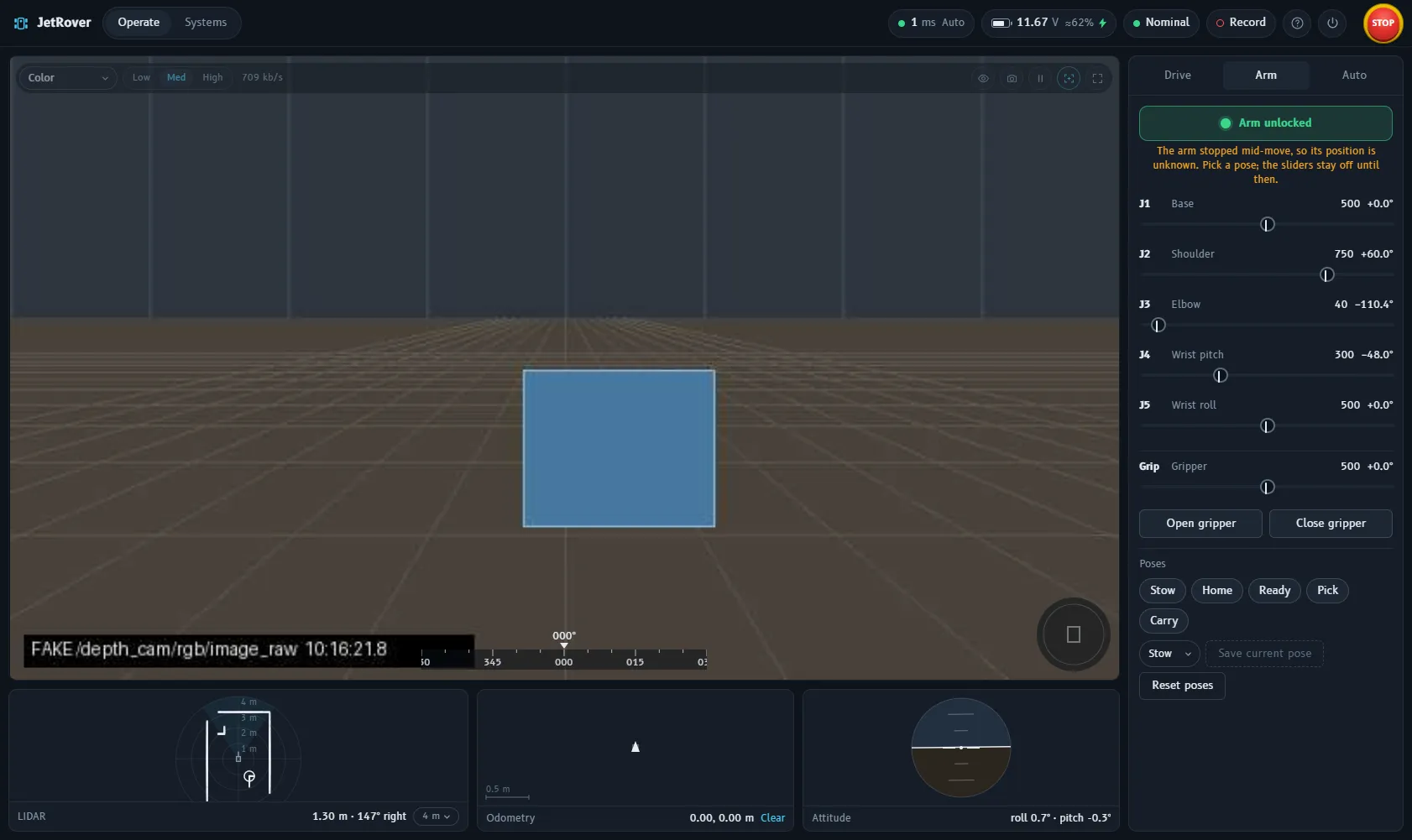
- Base. Velocity commands are capped at 0.20 m/s and 0.50 rad/s and sent at 15 Hz while moving. A stop is three zero commands and then silence.
- Arm and gripper. Joint targets in servo pulses, and a grip mode where the gamepad’s right trigger sets the gripper target at 15 Hz. That trigger is what closed the gripper in every grasping demonstration.
- Enabling. Only a click turns drive on, and an input that is already held has to pass through neutral first, so a stuck key or a resting thumb cannot start the robot.
Stopping
Teleoperation over a network has to assume the link will fail. The deck stops in layers, and I measured what each layer does and does not catch.
- In the browser. Drive switches off when the window loses focus, the tab is hidden, the link drops, or the robot stops answering a ping for 2.5 s. Nothing is sent while disconnected.
- E-stop. A button, the space bar, Escape, or a gamepad button. It sends five zero commands on both velocity topics, switches drive off, locks the arm, and triggers the servos’ own stop, twice. Only a pointer click releases it.
- On the robot. A watchdog node zeroes the base when commands stop arriving for 0.5 s. On the second velocity topic, where silence is normal, it stops the base when a publisher disappears while the last command was not zero.
That second guard, tested in an isolated ROS domain:
| Case | Result |
|---|---|
| A steady 4 s hold | Left alone |
| A clean exit while driving | Stopped 69 ms later |
| A node that sent its own stop and then exited | Left alone |
| A node killed without warning | Stopped 17.7 s later, when the middleware’s lease ran out |
| A node that hangs | Not caught |
The last two rows are the honest part. Graph-based detection is only as fast as the middleware’s liveness timeout, and it cannot see a publisher that is alive but stuck. A deadline on the message stream would catch both; that is what the first guard does on the topic where a steady stream is expected.
Recording episodes
The recorder is a ROS node that writes rosbag2 episodes, controlled from the deck.
- It stores raw messages as they arrive, with no resampling: by default 20 topics, among them the compressed camera image, lidar, IMU, transforms, the measured servo positions, both velocity topics, the servo commands and the gripper force.
- An episode starts with a task description and ends with an outcome and notes. Marks can be dropped during it.
- It stops by itself after 15 minutes, when free disk space falls under 5 GB, or when the clock jumps by more than 2 s.
- Next to each bag it writes a sidecar file: task, outcome, marks, stop reason, message counts per topic, camera intrinsics, and a map of state and action features with their units, so an episode can be converted for training without guessing.
The grasping demonstrations themselves use a separate recorder, written later for that experiment, which aligns both cameras, the joints and the force window at 30 Hz. It is described on the force-aware grasping page.
The servo driver: eight defects
All of this depends on the vendor’s driver for the servo controller board. Seven of the defects below were in it. The eighth I introduced while fixing the sixth.
| Defect | Fix | |
|---|---|---|
| D1 | A servo read waited forever. One missed reply froze the base and arm commands | Every read has a 100 ms deadline, and reads run apart from motor commands |
| D2 | Replies were never matched to requests, and a full one-slot queue dropped the new reply | Stale replies are drained first; a reply must match in length, command and servo id |
| D3 | Asking for voltage or torque called functions that do not exist and crashed the node | The right functions are called; a failed read reports failure |
| D4 | The torque switch had its two codes swapped. It dropped the arm once | The codes are swapped back, and every switch is confirmed by reading it back |
| D5 | The gripper stops short of its target against its own friction and keeps pushing: 74 to 78 °C after every restart, against a limit of 85 °C | The driver reads where the gripper stopped and holds it there. A grasp is eased to a holding grip and relaxed at 75 °C |
| D6 | Nothing published measured positions | A topic with all six measured positions at 30 Hz, only while something subscribes |
| D7 | Any malformed message killed the node. The board holds the last wheel speed, so a crash while driving meant a runaway base | Every callback is guarded, any exit zeroes the motors, and the driver respawns |
| D8 | Mine, from D6. The position polling took the bus lock again within microseconds, so waiting commands lost every time: more than half were dropped and the rest arrived up to half a second late | The polling steps aside before each read whenever a command is waiting |
Measured on the robot with the stack running, 16 November 2026:
| What | Result |
|---|---|
| One servo read | 3.7 ms median |
| Measured positions | 30.0 Hz, all six servos in every message |
| Driver CPU when idle | 12.0 %, against 16.7 % for the vendor’s |
| Respawn after a forced kill | New process in 2.0 s |
| Gripper temperature after a restart | 33 to 34 °C, flat for 5 minutes |
And for D8, on a fake board on the loaded robot, 120 commands at 60 Hz while positions are polled:
| Before | After | |
|---|---|---|
| Commands that reached the bus | 56 of 120 | 120 of 120 |
| Wait, median | 199 ms | 10 ms |
| Wait, longest | 468 ms | 20 ms |
Tests
362 automated test cases cover the logic that can be tested without the robot: 227 in Python for the deck’s services, 40 for the driver against a fake controller board, and 95 in JavaScript for teleoperation, the arm stop, the gamepad and the link handling. A 36-check script then verifies the driver on the robot itself.
Limits
- The supervised first-motion checkout of the deck is not finished: its later steps are still to do.
- The arm’s E-stop is proven down to the packet on the serial line, and on an arm that was standing still. It has not been proven on a moving arm.
- The deck’s autonomy mode runs in dry run. Nothing moves.
- Long grasps settle near the gripper’s 75 °C guard after about five minutes, so a long hold still needs force control and not a position offset.